Swiss glaciers lost 5.5% of their ice in a year and nearly a fifth since 2021
A snow-poor winter and a record-hot summer left Swiss ice bare. Monitors say 2.2 trillion litres of meltwater ran off between July and September.
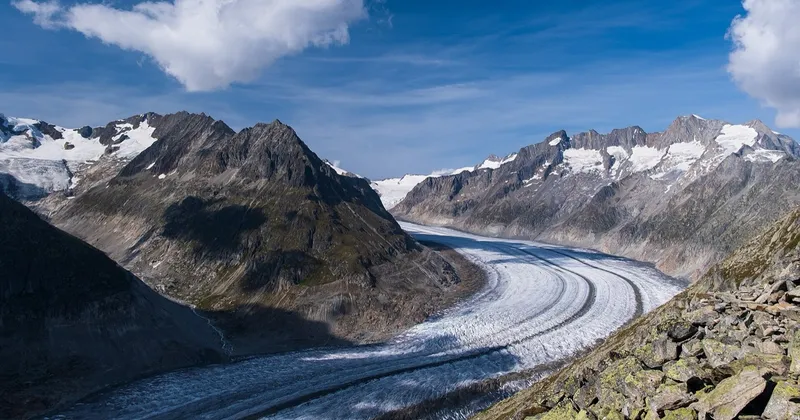
Swiss glaciers shrank by 5.5% of their ice volume in the year that ended on 30 September, according to the country’s glacier monitoring network, GLAMOS, working with the Swiss Academy of Sciences. Taken together with the previous four years, that is nearly 20% of all Swiss glacier ice gone since 2021. The annual figures were released at the start of October. They did not match 2022, still the record year, but they came close enough to make the same point.
A percentage of volume hides how it looks on the ground, so the details matter more than the headline.
Ice with no blanket
Two things went wrong at once. The winter of 2025–26 was one of the ten least snowy since measurements began, according to the ETH Zurich release that accompanied the data. Then the summer arrived hot and dry. The freezing level sat above 4,000 metres for 76 days, more than twice the average and a Swiss record. By September there was no snow left even at 3,500 metres, so the ice had nothing between it and the sun.
Snow matters because it is a reflective lid. Fresh snow throws most sunlight back; bare ice absorbs much more of it and melts faster. A thin winter followed by a long heatwave removes the lid early and leaves the glacier exposed for most of the season.
Matthias Huss, who heads GLAMOS and is a lead researcher on the report, told Al Jazeera that this was the hottest summer on record in Switzerland. He gave a concrete example from the Scex Rouge glacier, at nearly 3,000 metres. A measuring pole of about four metres had been drilled into the ice in July; by September roughly three metres of it stood exposed. That loss came in August and September alone, on top of what the June and July heatwaves had already taken.
What the survey measured
- Average glacier thickness fell by 2.5 to 4 metres in 2026, and some glacier tongues lost up to 10 metres.
- A GLAMOS team measured 23 glaciers at the end of summer.
- The Rhône, Aletsch and Clariden glaciers each set a record for their own melt. Two glaciers, Bella Tola in Valais and Griessfirn in Glarus, have disappeared for good.
- Between July and September, about 2.2 trillion litres of water ran off the ice, more than four times what all Swiss households drink in a year.
The monitors are careful about one comparison. The 2026 melt did not reach the overall rates of 2022, the record year. So 2026 was not a freak that broke the pattern; it was another very bad year in a short run of them.
Why water managers care
For the past few decades, glacier melt has quietly cushioned dry summers. The ETH release makes the point that melting ice eased summer water shortages this year, but it describes the contribution as a shrinking resource, because the glacier area keeps getting smaller and the loss is not reversible on human timescales.
Harry Zekollari, a glaciologist at Vrije Universiteit Brussel, told Al Jazeera that summer meltwater supply across the European Alps has already peaked and will decline from here. The glaciers also feed hydropower reservoirs and some of Europe’s big rivers, and tourism, which employs around 4% of the Swiss workforce, leans on white mountains. Huss put it plainly: peaks are turning grey and black rather than white.
Small glaciers go first. Melting hit all the ice in a similar way, the Al Jazeera report notes, but the little ones shrink fastest and some are now gone entirely, while the big valley glaciers lose enormous volumes and still stand.
What is still open
Nobody can say these glaciers will vanish on a schedule. Zekollari’s framing is conditional. If emissions are stopped quickly, roughly a third of the present Alpine glacier mass could be saved; under strong warming, losses of more than 90% of volume by 2100 are possible. Globally, he said, glacier mass loss by 2100 could be around 25% under limited warming or around 50% under greater warming, and every extra tenth of a degree counts.
Two cautions on the data. The ETH release describes the figures as averages from an observational survey, so single glaciers can sit well above or below them. And the five-year comparison is described as “nearly” 20%, not a precise tally. Neither caveat changes the direction. The next annual survey will show whether this year was another step down or a brief reprieve.
Sources
More in Science & Climate
-
El Niño is still strengthening, and NOAA now puts a historic event at about 60%
NOAA's 12 November update and NASA satellite maps both point to an El Niño that rivals 1997-98. Neither agency can yet say where the worst effects will land.
-
A 47-million-year-old owl with a cockroach in its stomach suggests early owls hunted by day
A new fossil from Germany's Messel Pit shows an owl that lacked the wing features for silent flight, narrowing when owls may have turned nocturnal.
-
Fossil CO2 is set to dip 0.4% in 2026, against cuts of about 6% a year needed for 1.5°C
The Global Carbon Budget projects a small fall in fossil CO2 this year, driven by an oil shock. UNEP's gap report shows how far that is from what 1.5°C needs.